 Code 10 / Code C1 • Manual
Manual Truck Driving Lessons
A complete, structured Code 10 programme — not simply driving a larger vehicle.
Students progress through vehicle knowledge, inspection, controls, hand signals, reversing, docking, road driving and test preparation.
Structured Code 10 Training From the Basics Up
Code 10 students must first understand the vehicle before being expected to perform advanced manoeuvres or drive in traffic. At Sam’s Driving Academy, we do not skip the basics. Each stage is taught, practised and assessed before the learner progresses.
Training Method
Every lesson must have a clear objective.
Understand the Vehicle
Before the student begins driving, they must understand the Code 10 vehicle and its controls.
Training includes:
- Correct seating position
- Mirror adjustment
- Steering position
- Pedal identification
- Gear positions
- Handbrake / parking brake
- Dashboard controls
- Indicators
- Lights
- Wipers
- Horn
- Warning lights
- Instrument panel
- Vehicle-specific controls
The student must know what the controls are and what they are used for.
Exterior Vehicle Inspection
Students must be trained on how to perform the required exterior inspection before driving.
Appropriate checks for the Code 10 vehicle:
- Tyres
- Wheels
- Lights
- Indicators
- Mirrors
- Windscreen
- Wipers
- Body condition
- Number plates
- Fluid leaks
- General vehicle condition
- Safety-related external components
The instructor should teach students both what to inspect and how to explain the inspection during the test.
Interior Vehicle Inspection
Students must also learn the required checks inside the vehicle.
This may include:
- Seat position
- Seatbelt
- Mirrors
- Handbrake
- Gear position
- Dashboard
- Warning lights
- Instruments
- Steering
- Pedals
- Vehicle controls
The student must become comfortable explaining these checks correctly and consistently.
Correct Starting Procedure
Before moving the vehicle, students should learn the proper starting procedure.
The instructor should teach the correct sequence, including:
- Safety checks
- Gear position
- Parking brake
- Mirrors
- Starting the engine
- Dashboard / warning-light check
- Observation
- Preparing to move off
The procedure should be repeated until the student can perform it without being prompted.
Hand Signals
Students should be taught the required driving hand signals and understand what each signal means, when it is used, how to demonstrate it correctly, and how to respond if asked during the test.
Relevant signals required for the Code 10 test:
- Turning / directional signals where required
- Slowing down
- Stopping
- Other prescribed hand signals
Do not simply show the signals. Students must practise physically demonstrating them until they are comfortable.
Basic Vehicle Control
Before docking or advanced reversing, the student must first understand how the larger vehicle responds.
Training should include:
- Moving off
- Clutch control
- Biting point
- Steering
- Gear changes
- Braking
- Speed control
- Vehicle width awareness
- Turning radius
- Observation
- Positioning
This stage is especially important because a Code 10 vehicle behaves differently from a smaller Code 08 vehicle.
Learn to Reverse Before You Learn to Dock
A learner should not immediately be expected to perform advanced docking. Start with straight reverse.
Straight reverse teaches:
- Steering while reversing
- Mirror use
- Slow-speed control
- Clutch control
- Vehicle positioning
- Keeping the vehicle straight
- Correcting the vehicle
- Judging distance
- Understanding the movement of the larger vehicle
Straight reverse provides the foundation for docking manoeuvres.
Left Docking / Alley Docking
Once straight reverse and basic control are understood, students progress to docking.
Training should include:
- Correct starting position
- Observation
- Mirror use
- Reference points
- Steering timing
- Vehicle angle
- Reverse control
- Alignment
- Corrections
- Final positioning
The student should understand why the vehicle moves in a particular direction, rather than only memorising steering movements. If the Code 10 test requires additional docking directions or variations, include them according to the applicable test structure.
Turning a Larger Vehicle
Code 10 students must understand that larger vehicles require different positioning and turning awareness.
Training should include:
- Left turns
- Right turns
- Correct road positioning
- Mirror checks
- Vehicle width
- Rear-wheel tracking
- Avoiding kerbs
- Safe turning speed
- Observation before and during turns
The student must understand how the rear of the vehicle follows a different path from the front.
How Each Manoeuvre Is Taught
Every Code 10 manoeuvre follows the same structured training process.
Instructor Explanation
Explain the manoeuvre and objective.
Instructor Demonstration
Show the student how it is performed.
Guided Practice
Student performs the manoeuvre with instructor support.
Repetition
Repeat the manoeuvre several times.
Independent Attempt
Student performs it with minimal instructor intervention.
Assessment
Instructor determines whether the learner is ready to move forward.
Road Training
Once vehicle control and yard manoeuvres are progressing well, training moves increasingly onto the road.
Students should be trained on:
- Lane positioning
- Intersections
- Stop streets
- Traffic lights
- Gear selection
- Speed control
- Following distance
- Observation
- Mirror use
- Larger vehicle positioning
- Turning
- Traffic awareness
- Defensive driving
- Hill starts
- K53 procedures
Code 10 road training should place extra emphasis on the size, weight and positioning of the vehicle.
You Move Forward When You Are Ready
Completing a lesson does not automatically mean that the student moves to the next skill.
If the student still needs work on:
- Clutch control
- Reversing
- Docking
- Turning
- Mirrors
- Gear changes
- Road positioning
The training programme is based on ability and readiness, not simply the number of lessons completed.
Every Code 10 Lesson Has a Purpose
Students should not spend lesson after lesson simply driving around without understanding what they are being trained to improve.
Every lesson should have:
- A defined objective
- Specific skills
- Repetition
- Instructor correction
- Progress feedback
- A recommendation for the next lesson
A student should always know: What am I learning? What am I improving? What still needs work? What is my next stage?
Test Preparation
As the Code 10 test approaches, lessons should become increasingly focused on test conditions. Where possible, preparation should include the relevant Traffic Department / test area.
Students should repeatedly practise:
- Exterior inspection
- Interior inspection
- Starting procedure
- Hand signals
- Yard manoeuvres
- Straight reverse
- Docking
- Road procedures
- Turns
- Observation
- Correct stopping
- Test-standard driving
The goal is for the entire test process to feel familiar by the time the student arrives for the official assessment.
Your Code 10 Training Journey
A structured sequence from vehicle knowledge to test readiness.
Vehicle Familiarisation
Exterior & Interior Inspection
Controls, Warning Lights & Starting Procedure
Hand Signals
Clutch & Vehicle Control
Straight Reverse
Docking / Yard Manoeuvres
Turns & Vehicle Positioning
Road Training
Test Preparation
Test Readiness
How Many Code 10 Lessons Will I Need?
Every learner progresses differently. The number of lessons required depends on:
Factors that affect the number of lessons:
- Previous driving experience
- Experience with larger vehicles
- Clutch control
- Gear-changing ability
- Reversing ability
- Docking
- Road awareness
- Confidence
- Lesson frequency
- Instructor assessment
- Test readiness
Students can add additional lessons whenever more preparation is required. A fixed lesson count is never a guarantee of test readiness.
“Code 10 training at Sam’s Driving Academy is a complete programme. Students learn the vehicle, inspections, controls, hand signals, reversing, docking, road driving and test procedures in a structured sequence.”
Code 10 lesson packages
Standard and student pricing — add a package to your cart and check out without leaving this page.
Code 10
StandardCode 10
Student* Student pricing requires valid proof of student status, uploaded before payment and reviewed by our team afterwards.
Common Questions
Do I need a Code 8 licence first?
No — you do not need a Code 8 (light vehicle) licence first. You must hold a valid Code 10 learner's licence to begin Code 10 driving lessons.
What vehicle will I learn in?
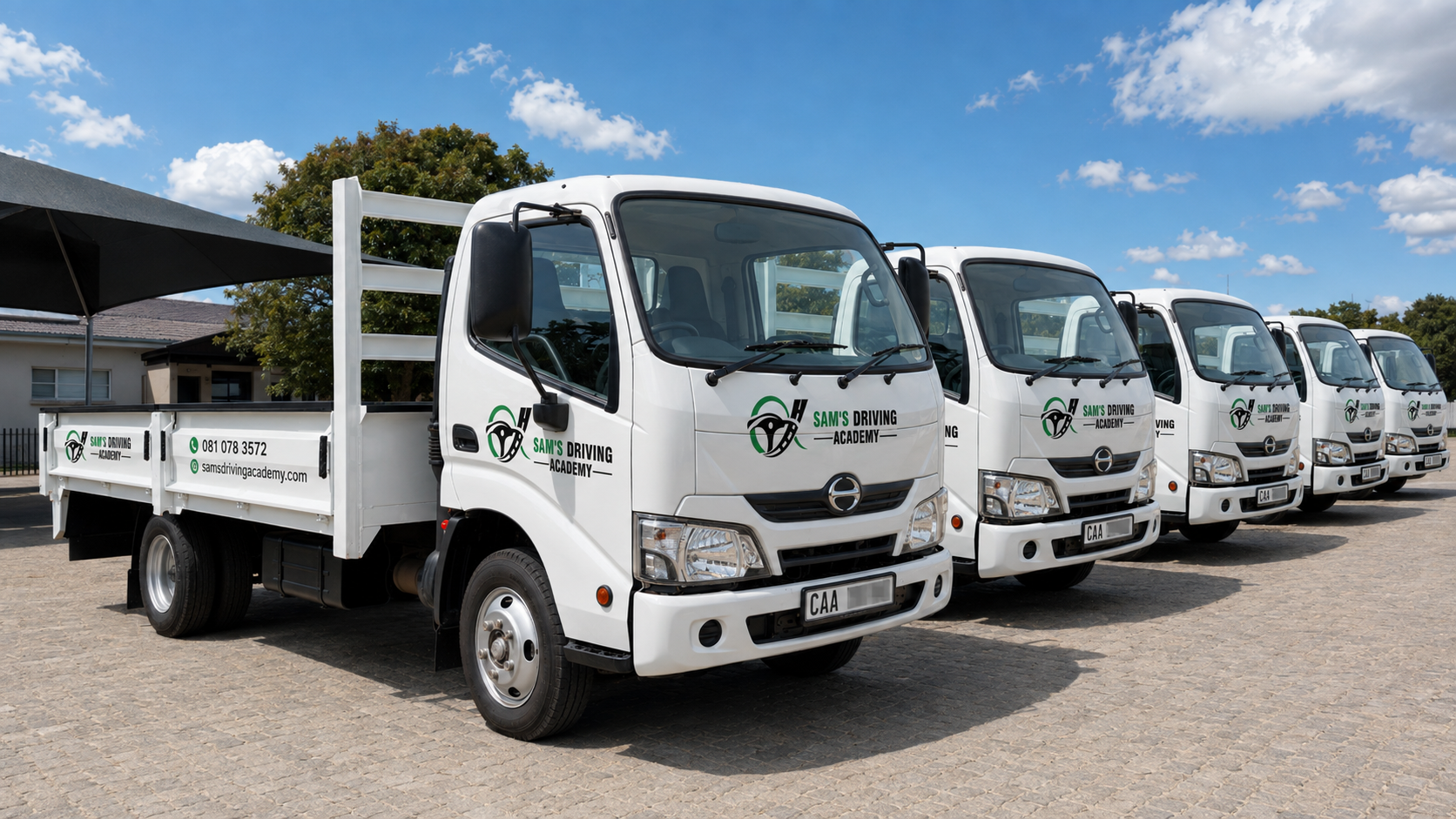
You'll train in a heavy motor vehicle (truck). Our instructors guide you through yard manoeuvres and road driving in a real test vehicle.
How many lessons are typically needed?
Most students require 10–20 lessons depending on their prior heavy vehicle exposure. Your instructor will assess and advise you.
What is a PrDP and do I need one?
A PrDP (Professional Driving Permit) is required if you plan to transport goods or passengers commercially. We can advise you on the process.