 Code 8 / Code B
Automatic Driving Lessons
Learn to drive in an automatic vehicle with structured, step-by-step training designed to build confidence, road awareness and test readiness.
With no clutch pedal or manual gear changes to manage, students can focus more directly on controlling the vehicle, understanding the road and preparing for the Code 08 driving test.
Less Focus on Gear Changes. More Focus on Driving.
Automatic vehicles remove the need for clutch control and manual gear changes, which allows many students to focus sooner on the skills that make them safe, confident drivers.
You Cannot Skip the Basics
One of the biggest mistakes learners make is trying to move too quickly into advanced driving or parking before mastering the fundamentals. At Sam’s Driving Academy, we do not believe that students become good drivers simply by spending lesson after lesson driving around.
Every lesson must have a purpose. Our training follows a structured progression where the student must first understand and practise the basic skill before moving to the next stage.
Our Method
The objective is not simply to complete lessons. The objective is to build the student’s ability correctly from the ground up.
Why Straight Reverse Comes Before Parking
Before a student is expected to perform parallel parking, alley docking and other more advanced parking manoeuvres, they should first understand how the vehicle behaves when reversing. That is why training should begin with a basic skill such as Straight Reverse.
Straight reverse teaches the student how to:
- Control the steering while moving backwards
- Understand how the vehicle responds
- Maintain a straight line
- Use mirrors correctly
- Control speed
- Judge distance
- Understand vehicle movement
- Make small corrections
Once the student understands how to control the vehicle in reverse, more advanced parking becomes easier to understand.
The same principle applies throughout the training programme — master the basic movement first, then build the advanced skill on top of it.
Your Training Is Built in Stages
Students should not simply jump from one topic to another. They progress through structured stages.
- Correct seating position
- Mirrors
- Steering
- Accelerator and brake
- Automatic gear selection
- Moving off
- Stopping
- Basic observation
For manual students, this stage also includes: clutch control, biting point, gear selection, and clutch and accelerator coordination.
We Do Not Rush the Student
Progress Is Based on Ability — Not Just Lesson Numbers
Completing a lesson does not automatically mean that a student is ready for the next skill. If the student still needs more practice with:
- Steering
- Straight reverse
- Parking
- Observation
- Road positioning
…then the instructor should continue working on that skill. We do not believe in rushing students simply to say that a topic has been covered.
Key Principle: Master the foundation first. The advanced skills become easier afterwards.
We Don’t Just Drive Around
Every Lesson Must Have a Purpose
Sam’s Driving Academy does not believe that driving lessons should simply consist of driving around different roads for an hour. Road driving is important, but it must form part of a structured learning plan.
Every lesson should have:
- A clear objective
- A skill being taught
- Repetition
- Instructor feedback
- Progress assessment
- A next-step recommendation
The student should know:
- What am I learning today?
- What did I improve?
- What still needs work?
- What will I learn next?
We Prepare You for the Full Test — Not Just the Driving
Before advanced manoeuvres and road driving, students are trained on the checks and procedures that form the start of every driving test.
Exterior Inspection
- Tyres, wheels & lights
- Indicators & mirrors
- Windscreen, wipers & body condition
- Number plates & fluid leaks
Interior Inspection
- Seat position & seatbelt
- Mirrors & handbrake
- Gear position & dashboard
- Warning lights & instruments
Starting Procedure
- Safety checks & gear position
- Parking brake & mirrors
- Starting the engine
- Dashboard check & observation
Vehicle Controls & Warning Lights
- Controls & indicators
- Lights, wipers & horn
- Dashboard warning lights
- Instrument panel
Seating, Mirrors & Safety
- Correct seating position
- Mirror setup
- Safety checks before moving off
Hand Signals
- What each signal means
- When the signal is used
- How to demonstrate it correctly
- Responding during the test
Your Automatic Training Journey
A clear, step-by-step progression for automatic students.
Vehicle Knowledge
Learn the controls, steering, pedals and automatic gear selection.
Inspection
Exterior and interior checks before driving.
Controls & Warning Lights
Dashboard controls and warning lights.
Starting Procedure
Correct starting sequence before moving off.
Hand Signals
Required driving hand signals for the test.
Automatic Vehicle Control
Steering, stopping, speed control and observation.
Straight Reverse
Reverse in a straight line and judge the vehicle.
Parking
Alley docking, parallel parking and other manoeuvres.
Road Training
Intersections, lane positioning, traffic and defensive driving.
Test Preparation
Combine all skills under test-type conditions.
Parking Is Built From the Basics
Parking should not be taught as a memorised sequence only. Students first need to understand:
Once these fundamentals are understood, the student can perform the full manoeuvre with much more confidence.
Students should practise parking repeatedly until the process becomes familiar and controlled.
Building Real-World Road Skills
Once the student has good basic vehicle control and understands the required manoeuvres, training becomes increasingly road-focused.
Because the vehicle handles gear changes automatically, many students are able to concentrate on road awareness sooner.
Preparing for Test Day
Closer to the test date, lessons should become more focused on test readiness. Where possible, training can take place around the Traffic Department or test area where the student will be writing.
The objective is for the student to feel familiar with the environment before test day.
Why Many Learners Choose Automatic
Automatic vehicles reduce some of the mechanical demands of learning to drive, which can allow many students to focus on road skills sooner.
Learn in Modern, Learner-Friendly Vehicles
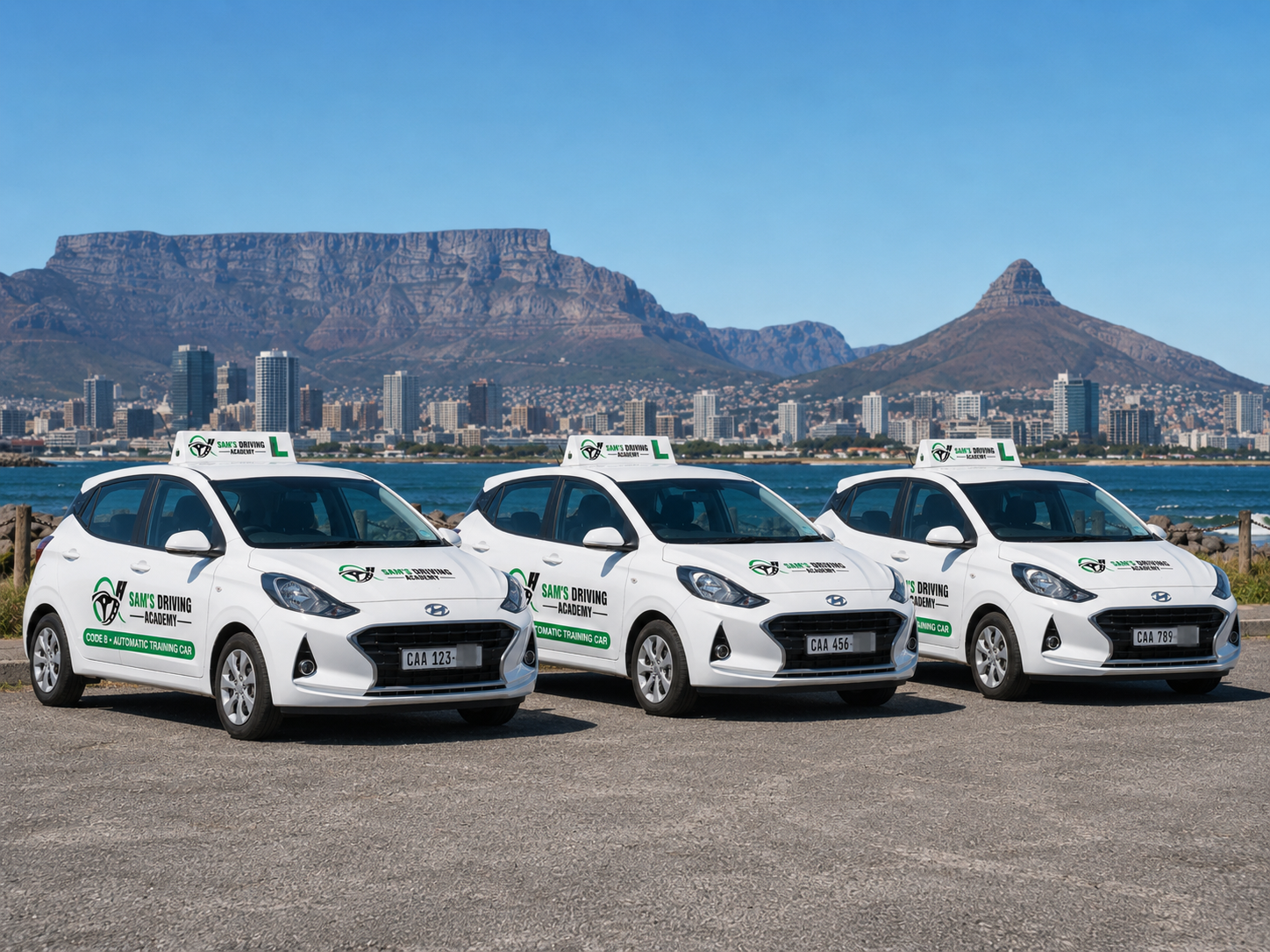
The academy uses modern automatic vehicles designed to make the learning experience comfortable and safe.
Where equipped, features may include
- Instructor-side dual-control brake
- Parking sensors
- Reverse camera
- Modern braking systems
- Easy steering
- Good visibility
- Modern safety technology
Your Instructor Can Assist in an Emergency
Selected training vehicles include an instructor-side brake, allowing the instructor to intervene if necessary during an emergency. This provides additional reassurance for beginner drivers.
Technology Assists — It Does Not Replace Training
Where vehicles contain parking cameras or sensors, these features help students understand distance and positioning. However, students must still learn proper K53 observations, reference points, steering technique and correct parking procedure.
The technology supports the learning process but does not replace proper driving instruction.
How Many Automatic Lessons Will I Need?
Every student progresses differently. The number of lessons depends on several factors:
What affects the number of lessons
- Previous driving experience
- Confidence
- Coordination
- Frequency of lessons
- How quickly skills are mastered
- Instructor assessment
- Test readiness
Complete beginners may require a structured series of lessons, while experienced or refresher drivers may need fewer.
Students can add additional lessons at any time if more preparation is required.
We Build Drivers Step by Step
A confident driver is not created by skipping the basics or simply spending hours driving around. Good driving comes from understanding each skill, practising it correctly, repeating it and then combining those skills together.
That is the Sam’s Driving Academy training approach:
At Sam’s Driving Academy, every driving skill has a foundation. Students progress through structured stages and only move forward once the fundamentals are understood.
Code 8 Automatic lesson packages
Standard and student pricing — add a package to your cart and check out without leaving this page.
Code 8 · Automatic
StandardCode 8 · Automatic
StandardStudent discount does not apply to Automatic.
* Student pricing requires valid proof of student status, uploaded before payment and reviewed by our team afterwards.
Common Questions
Is an automatic licence easier to get?
The K53 rules, road signs and test procedures are exactly the same as for a manual licence. The difference is that you will not be tested on clutch control or manual gear changes. Automatic training is still fully structured — you learn vehicle control, parking, road driving and test preparation.
Can I drive a manual car with an automatic licence?
No — an automatic licence only permits you to drive automatic vehicles. If you want to drive both, choose the manual licence.
How many lessons will I need?
Every student progresses differently. Complete beginners may require a structured series of lessons, while experienced or refresher drivers may need fewer. Your instructor will assess your progress and you can add more lessons at any time if more preparation is required.
Do you cover my suburb?
We serve a wide range of Cape Town suburbs. Check our Pick-Up Areas page for the full coverage map.