Should I Learn Manual or Automatic?
This is one of the most common questions new drivers ask — and there is no single correct answer. The right option depends on the learner, the type of vehicle they expect to drive, and the flexibility they want from their driving licence.
The answer depends on:
- What type of vehicle you plan to drive
- Whether you want the flexibility to drive both transmission types
- How quickly you want to become comfortable behind the wheel
- How comfortable you are managing gears and clutch control
- The vehicles available to you at home or work
- Your personal preference
Neither option is automatically "better". The best choice is the one that fits your future driving needs.
Before You Choose, Understand the Licence Difference
This is the single most important factor to understand before deciding which vehicle to use for your driving test — because it directly affects what your licence allows you to drive afterwards.
Pass in a manual vehicle and you may drive:
Drive both — maximum flexibility
Pass in an automatic vehicle and your licence carries an automatic-transmission restriction:
Automatic only — restriction applies
Technically the licence records the vehicle category and any restrictions. Passing in an automatic vehicle results in an automatic-transmission vehicle restriction. This is one of the biggest factors to consider before deciding which vehicle to use for your driving test.
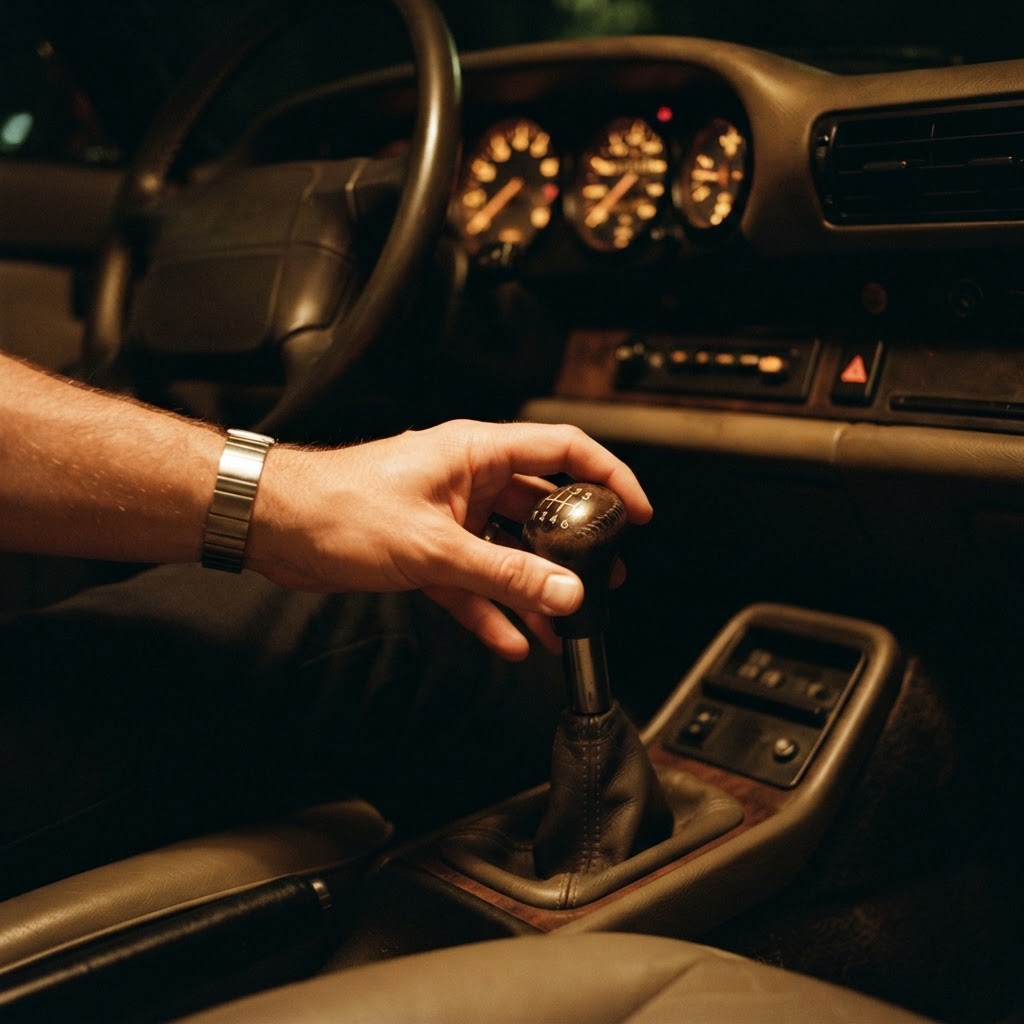
Learning to Drive a Manual
Manual driving requires the learner to manage more vehicle controls at the same time. As a manual learner, you have to learn:
- Clutch control
- Finding the biting point
- Moving off smoothly
- Changing gears — up and down
- Selecting the appropriate gear
- Controlling the vehicle on inclines
- Preventing stalling
- Coordinating clutch and accelerator
- Managing the vehicle while still completing observations
Manual driving can initially require more coordination because the learner is managing the clutch, gears, accelerator, steering and observations together.
Manual Vehicle
You manage:
- Clutch pedal
- Gear lever (change up & down)
- Accelerator
- Brake
- Steering
- Biting point & hill starts
Automatic Vehicle
You primarily manage:
- Accelerator
- Brake
- Steering
- Gear selector (when required)
- Mirrors & blind spots
- Observations & road positioning
Why Choose Manual?
1. Greater Licence Flexibility
The major advantage is flexibility. If you successfully complete your driving test in a manual vehicle without an automatic-transmission restriction, you are not restricted to automatic vehicles. This can be useful when:
- Borrowing vehicles
- Buying a different vehicle in future
- Driving company vehicles
- Applying for jobs where manual vehicles are used
- Driving older vehicles
- Travelling where a manual vehicle may be the only available option
2. Learn More Vehicle-Control Skills
Manual driving teaches the learner to understand gear selection, engine response, clutch control, hill starts, changing down, and the relationship between vehicle speed and gear selection.
3. More Options Later
A student may not know what type of vehicle they will be driving in five or ten years. Choosing manual can provide additional flexibility down the line.
What Makes Manual More Challenging?
A new learner must coordinate several things simultaneously. The sequence can look like this:
Common manual challenges
Observe → clutch → select gear → accelerator → release clutch correctly → steer → observe again
- Stalling
- Rolling backwards
- Releasing the clutch too quickly
- Selecting the wrong gear
- Forgetting to change down
- Changing gears too early or too late
- Concentrating on gears and forgetting observations
- Difficulty with clutch control during parking
- Nervousness on inclines
Sam's Tip
Don't interpret early difficulty with clutch control as meaning you cannot drive manual. For many learners it becomes much easier once muscle memory develops.
Learning to Drive an Automatic
Automatic vehicles remove the need for the learner to manually operate a clutch and continuously change gears. Normally the learner primarily manages:
- Accelerator
- Brake
- Steering
- Gear selector when required
- Mirrors
- Blind spots
- Signals
- Observations
- Road positioning
- Traffic conditions
Because there is less mechanical coordination to manage, many beginners find automatic vehicles easier to learn in.
Why Choose Automatic?
1. Easier Vehicle Control for Many Beginners
- No clutch pedal and no regular manual changing of gears
- Concentrate more attention on steering
- Observations
- Road positioning
- Traffic and intersections
- Speed and other road users
2. No Manual Clutch Control
- No biting point to learn
- No clutch balancing
- No clutch-and-accelerator coordination
- No manual gear changes
3. Lower Risk of Stalling
An automatic vehicle generally removes the clutch-related stalling problem experienced by beginners in manual vehicles.
4. Modern Driver Assistance
Some of Sam's Driving Academy's newer automatic vehicles may include technologies such as hill-start assistance or hill-hold functionality. Where fitted, these features can make incline control easier.
Vehicle behaviour differs between models. The learner must still demonstrate proper vehicle control — do not assume an automatic can never roll backwards.
Automatic Does Not Remove K53 Observations
This is important. Do not tell learners that they only need to perform "two observations" because they are driving automatic. The K53 observation principles still apply.
Learners still need to demonstrate appropriate:
- Mirror checks
- Blind-spot checks
- Observations before moving
- Observations during manoeuvres
- Signals
- Intersection observations
- Lane-change observations
- Awareness of surrounding traffic
The advantage of automatic is that the learner has fewer mechanical tasks competing for their attention.
Same responsibility on the road. Less gear and clutch management.
What Should You Consider Before Choosing Automatic?
The biggest consideration is the licence restriction. If the learner takes and passes the practical driving test in an automatic vehicle, their licence carries an automatic-transmission restriction.
This may not be a problem at all for someone who:
- Owns an automatic
- Plans to purchase an automatic
- Has automatic vehicles at home
- Expects to drive automatic vehicles long term
- Has no need to drive manual vehicles
For these learners, automatic can be an excellent choice.
So, Which One Should You Choose?
Choose Manual If...
Manual may be the better option if:
- You want the flexibility to drive both manual and automatic vehicles
- You expect to use a manual vehicle
- Your family vehicle is manual
- Your work may require manual driving
- You don't mind spending additional time mastering clutch and gears
- You want broader vehicle flexibility after qualifying
Choose Automatic If...
Automatic may be better if:
- You know you will primarily or exclusively drive automatic vehicles
- Your personal or family vehicle is automatic
- You want to reduce the mechanical workload while learning
- Clutch and gear coordination is making learning unnecessarily difficult
- You would rather concentrate more learning attention on road awareness and vehicle positioning
- You understand and accept the automatic-transmission licence restriction
Your Friend's Choice Doesn't Have to Be Your Choice
Your friend may have learned manual because their family owns a manual vehicle. Another learner may choose automatic because every vehicle in their household is automatic. Both decisions can make sense. Choose according to your own circumstances.
Manual vs Automatic at a Glance
| Consideration | Manual | Automatic |
|---|---|---|
| Clutch pedal | Yes | No |
| Manual gear changes | Yes | No |
| Changing up / down | Yes | Automatic |
| Beginner learning curve | Generally higher | Generally easier |
| Risk of clutch-related stalling | Yes | Generally no |
| Clutch control required | Yes | No |
| K53 observations required | Yes | Yes |
| Drive automatic after qualifying | Yes | Yes |
| Drive manual after qualifying | Yes — no automatic restriction | No — automatic restriction applies |
| Best for | Maximum flexibility | Simpler vehicle operation |
Clutch pedal
Manual
Yes
Automatic
No
Manual gear changes
Manual
Yes
Automatic
No
Changing up / down
Manual
Yes
Automatic
Automatic
Beginner learning curve
Manual
Generally higher
Automatic
Generally easier
Risk of clutch-related stalling
Manual
Yes
Automatic
Generally no
Clutch control required
Manual
Yes
Automatic
No
K53 observations required
Manual
Yes
Automatic
Yes
Drive automatic after qualifying
Manual
Yes
Automatic
Yes
Drive manual after qualifying
Manual
Yes — no automatic restriction
Automatic
No — automatic restriction applies
Best for
Manual
Maximum flexibility
Automatic
Simpler vehicle operation
Still Not Sure?
Quick Decision Guide
Question 1 of 4
Do you expect to drive a manual vehicle in future?
These questions are a guide only. The final decision belongs to the student.
At Sam's, You Choose
At Sam's Driving Academy, we don't believe every learner should automatically be pushed toward manual or automatic. We explain the advantages, disadvantages and licence implications of both and allow the learner to make an informed decision.
If you want maximum flexibility, manual may make more sense. If you know that automatic is what you intend driving and you want a simpler learning experience, automatic may be the right choice.
The decision is yours. Our job is to help you become a safe and confident driver in whichever option you choose.
Already Started Manual but Thinking About Automatic?
Struggling with manual does not mean you have failed. You can discuss your progress with your instructor, who can help determine whether more manual practice is appropriate, whether additional clutch-control sessions would help, whether you should continue with manual, or whether switching to automatic better suits your circumstances.
We do not automatically encourage a switch. The decision remains with the learner.
Ready to Start Driving?
Choose the option that works for you.
Related Articles
 Learner's Licence
How to Pass Your Learner's Licence Test in South Africa
Learn how to prepare for your learner's licence test with structured study material, practice tests, mock exams, wrong-answer reviews and progress tracking through Sam's Learning Hub.
 Test Day
What to Expect on Your Driving Test Day
Preparing for your K53 driving test? Learn what happens during the vehicle inspection, yard test and road test, what your examiner checks and how to prepare for test day.
 App & Technology
How the Total Drive App Transforms Your Learning
Our app isn't just a booking tool — it's your complete learning companion. Discover how video tutorials, progress tracking, and smart scheduling give you an edge.